Many Geometry teachers know, that students do not buy into these two Mathematical Practices right away: they are more likely to skip to conclusions (often-incorrect ones) and write down their answers (if they, actually, get to any). It takes a big effort and perseverance on both sides (tchrs' and ss') to finally get clear justifications in students' work, which are the demonstration of "Making Sense of Problems and Persevere in Solving Them".
I do not know how much of this struggle is about overcoming students' disbelief in the need for this extra effort and how much comes from the fact that they feel overwhelmed and confused with the steps, since they do not, yet, have clear "cause-and-effect" connections within a new topic. This might be individual, but I did notice, that when they work with flow-charts, mind maps or at least solved-examples, there is less of that resentment and more of communication between my learners. Over time I came to the conclusion, that we (ss and I) were getting better results, if we approached learning in strides. I am attaching a GIF that shows the break-down of how I teach basic Geometry terms, relationships and diagramming. Feel free to download it. It the previous post you can find a video with the same GIF, in case it is easier for you to use.
First, we want to have strong connections between just a few Geo vocabulary terms, such as Segment Bisector-Midpoint-Congruent Segments (see my earlier post about it HERE).
Then, we want to show consistent applications of those terms to various problems. That is where we practice structure and make connections with similar situations or draw conclusions that there are no connections, and justify why. We work with this sort of practice using only one idea at a time (ex. Segment Bisectors; Angle Bisectors; Special Angle Pairs).
I included the summary mind map, which lures students into such exercise and may be used either on four different occasions, or during a summary lesson.
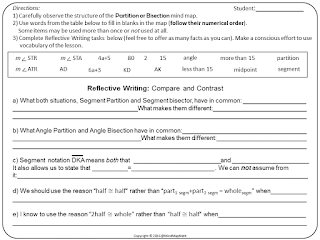
Third stage usually involves interleaving practice (more on this HERE), which calls for students' focus on "comparing and contrasting" between all terms withing a unit and related situations. This is when I would normally give a follow-up writing assignment, asking students to zero-in on certain aspects of the topic. This is a sample of such assignment.
We, teachers, experience it almost every week: our kids may "get" the material on a day-to-day basis,when it is taught one idea at a time, but once they are at the point when they have to deal with a mixed bag of questions, some of students have trouble even starting. I believe that it is very important to let our students know of this very well-recognized psychological phenomenon and that it should be expected. Every learner has experienced it at some point: as beginners, we might know chunks of information, but most likely, we have not, YET, see connections between them or even developed retrieval mechanisms for initiating them. Sometimes getting over this hump takes us longer then other times...but being aware of it, definitely helps students avoid much of the frustration related to the process. It is very easy for us, teachers (aka masters of the topic at hand) to take for granted our ability to see the whole picture, and underestimate the value (and magnitude) of students' struggle here. Meanwhile, this experience can be transformed into one of those GRAND teachable moments, that, perhaps, explain why we want our children to learn Mathematics...It shows, that mastery starts with learning facts, comparing and contrasting, deciphering through relevant traits, trying them out, and, maybe, identifying illusions of competence, and tuning up the process along the way. Mastery comes with perseverance ...just like in real life... INTERLEAVING -doing a mixture of different kinds of problems-is what I use to help students to move from a novice to an experienced learner of the topic. Below is a short video of the mind map that my students will have by the end of the Units on Basics of Segment and Angle Relationships. We summarize new material into CHUNKS reflected by this map (same order as in the clip) after learning new terminology, use of symbols and appropriate diagramming. At the end of the unit, we use this map to help with learning how to shift our mental gears from one situation to another. The poster of this map became a very handy reference when we needed to bring back the structure of communicating about geometric relationships throughout the school year. Usually, these two topics are taught in the beginning of a course, which makes them vital for an easy student transition to the new level of expectations to their work. I find, that students whose attendance was spotty during this time, have a much harder way of finding a good standing with the subject. I can not control their attendance, but at least I can make an attempt to help them catch up. Later on, I will be posting the videos that give a thorough overview of the material in the CHUNKS of this map.
I bet that regardless of how seasoned one is as a teacher, there is always a question in one's mind about the best way to spend that first week of school...
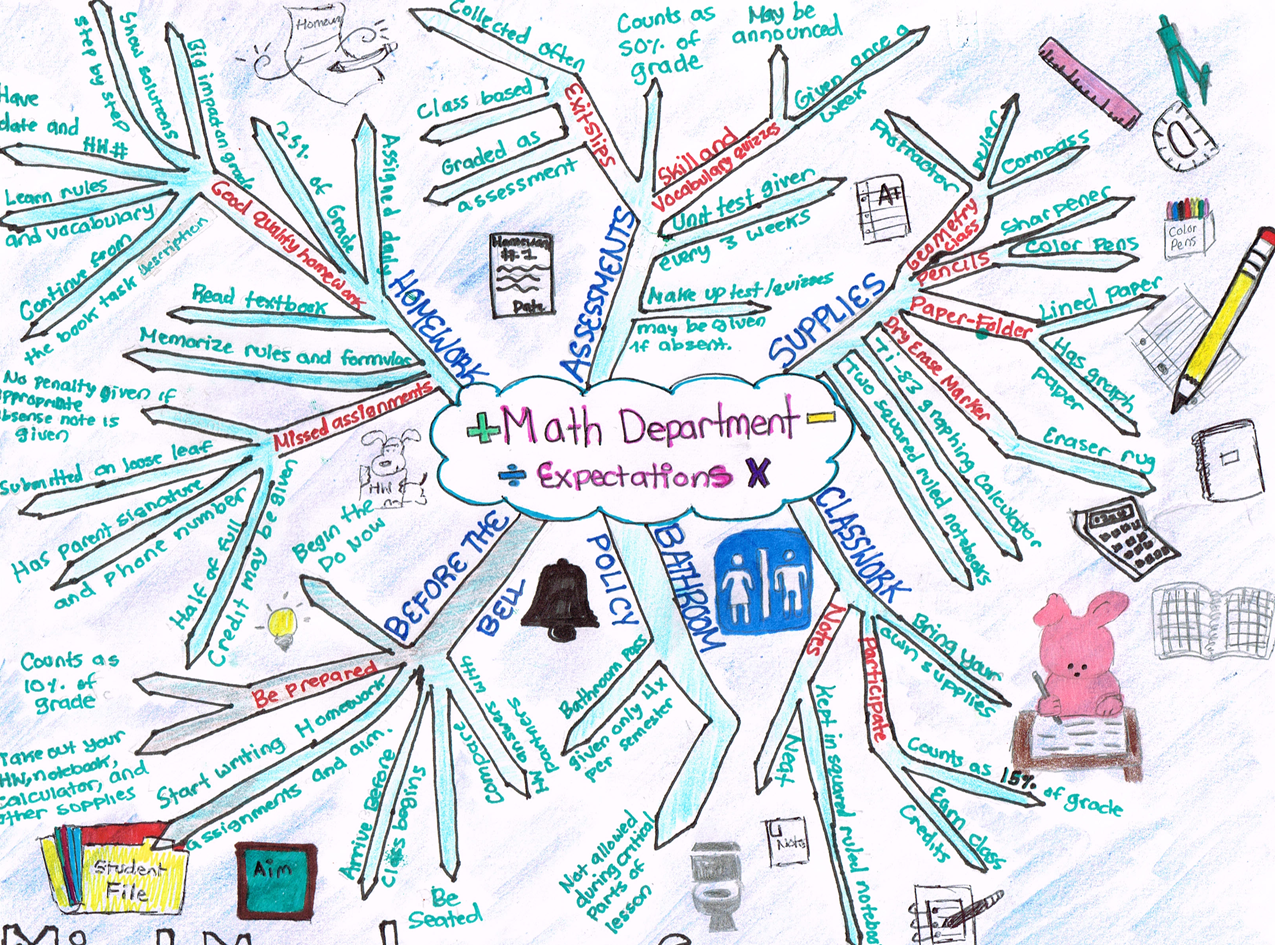
It is the time to establish procedures, lay out expectations and open lines of communication. I also find it to be the best time to start building the Thinking Culture. Throughout the year my students and I consistently work on making connections between the topics we learned or were familiar with before a course started. I often model the creation and use of mind maps, and it had always been on my mind how to help students come up with their own ones, rich with knowledge at their current curriculum level. I had some success with it over the years, but I always felt that there could have been a better way to explain how I want my students to work on it. I realized that it makes more sense to have this conversation far removed from Geometry topics, but with something engaging, something that kids could be curious about, yet not overwhelmed by it. I chose the topic of Saving Energy. Last year I finally structured it into a formal How To Mind Map Lesson Plan for the first week of school. This kind of helped me commit to the idea of weaving Mind Mapping throughout the curriculum. This meant that my expectations for the amount of work we would be able to get out of "thinking this way" during the school year was doubled, and doubled it was! I followed up with a little home project on making a mind map on class expectations, and was pleasantly surprised with the outcomes: so many students demonstrated artistic skills and creativity well above and beyond my own... and one more surprising effect: seeing the results actually changed my first impressions of the students or, rather helped me see their facets that I had not seen yet... I included some samples for your appreciation.
This summer, the "silly" in me, and the spirit of experimentation, helped me make the video (see below), in the hopes that it will be easier for my students to refresh our class conversation, when it starts to fade away. Feel free to check it out here or on my youtube channel. It is one of my first ones...but it already gave me a taste of skills for the 21st century...but it could be a different post...
So...for this September I animated my lesson and Included the Project description in SmartNotebook, to make the presentation more streamlined, with visuals, to get my point across faster, plus, if my colleges ever wanted it, it would be available for them.
It is that time of the year again...the first day of school is almost here!
It promises to be interesting, just look at this page-the evidence of me e-volving into an online collaborator! I have learned so much over the summer about the possibilities of online learning, that it was unacceptable to ignore them any longer...gotta start moving in this direction. After all, how would I teach my kids the 21st-century skills?!!
As usually, I started the preparations to the new school year with going over my “First Day of School” materials: tweaking them, choosing the most appropriate… here are few of those that I would like to share. They served me well, keeping me organized, with the information “at the tips of my fingernails” even before I could reach for a keyboard.